
Peptide Reconstitution Calculator

Calculate dilution and reconstitution with clarity, adjusting mass, volume, and concentration in seconds; discover how to use it on this page.
Adjust your syringe to:
0
Units (UI)
Equivalent to:
0
Milliliters (mL)
⚠️ Attention: The calculated volume exceeds the capacity of the selected syringe. Consider using a larger syringe or dividing the dose.
🔴 Syringe in Units (UI)
0102030405060708090100
🔵 Syringe in Milliliters (mL)
00.10.20.30.40.50.60.70.80.91.0

Guide to Diluting and Reconstituting Peptides

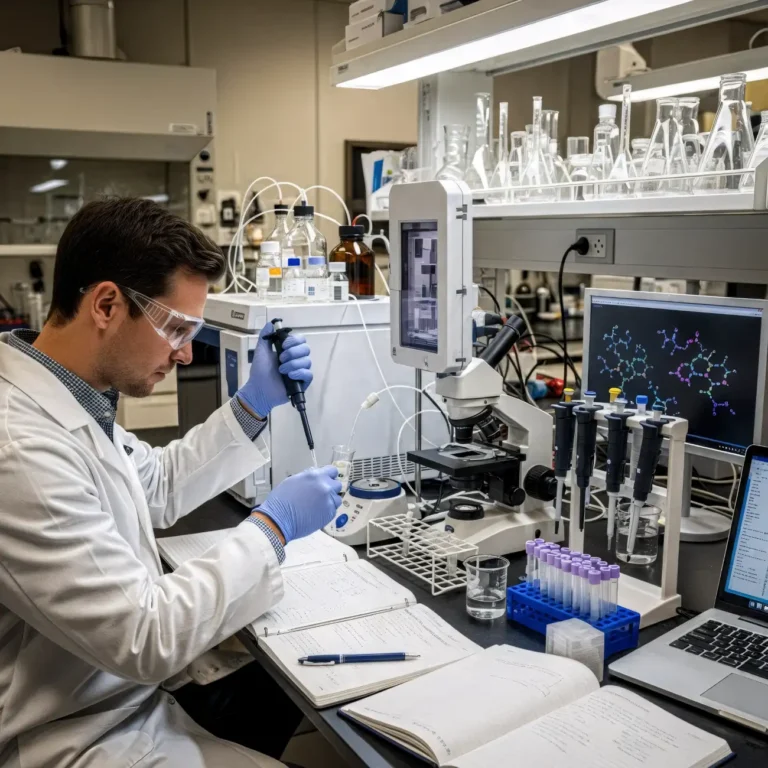
Peptide reconstitution is a critical step in research and laboratory settings, where lyophilized peptides (powder obtained by freezing and dehydration) are dissolved in an appropriate diluent to form a usable solution for experimental protocols. When done correctly, this step helps maintain consistent concentration, stability, and reproducibility in assays.

Lyophilized peptides are supplied in powder form to increase stability during transport and storage. Before use, it is necessary to determine the diluent and the volume to be added to the vial to achieve the desired concentration. The Peptide Dilution Calculator automates these calculations and unit conversions, reducing common errors and speeding up solution preparation.
How to use the peptide calculator

Use the calculator to quickly arrive at the final concentration and volume per aliquot, with less risk of unit error.
1. Report the mass of the peptide (mg) indicated on the vial.
2. Enter the volume of diluent (mL) to be added to the vial.
3. Enter the target concentration as indicated on the vial (mcg/mg, when applicable).
4. Select the aliquot volume (mL) (e.g., 0.3 mL, 0.5 mL, or 1 mL).
5. Check the result: the calculator performs the necessary conversions and returns the calculated value for the preparation and standardization of the reconstitution.
Tip: Always review mg × mcg and total mL × mL per aliquot before applying to the protocol.

How to choose the right thinner

The diluent directly influences solubility, stability, and compatibility with your protocol. Whenever possible, use the product’s COA/documentation and the type of application (assay, cell culture, etc.) as a guide.

Bacteriostatic water

Water with preservative (usually 0.9% benzyl alcohol), useful when the bottle will be accessed frequently. May not be the best choice for peptides sensitive to this preservative.

0.9% saline solution (NaCl)

Isotonic medium, often chosen for preparations that require greater physiological compatibility, including in the context of biological systems and cell culture (as required by the protocol).

Buffer solutions (e.g., PBS, HEPES)

They maintain a controlled pH. Buffer selection should consider the characteristics of the peptide (e.g., behavior at different pHs) and the needs of the assay.

Acetic acid in water (0.1% to 10%)

A common alternative for peptides with low solubility in water or at neutral pH, aiding in initial dissolution before adjusting the preparation for final use.


Best practices for peptide reconstitution

1. Use gloves and handle materials cleanly to reduce the risk of contamination and loss of material integrity.
2. Allow the bottle to reach room temperature before opening, minimizing condensation and variations that can affect stability.
3. Add the thinner slowly along the inside wall of the bottle, avoiding pouring it directly onto the powder — this helps prevent foaming and improves dissolution.
4. Mix gently (swirl/invert slowly). Avoid vigorous shaking, which can create foam and increase the risk of degradation.
5. If dissolution is difficult, consider gentle heating (30–40 °C) or short sonication. Avoid prolonged sonication.
6. When the protocol requires sterile conditions, use 0.22 μm filtration (when compatible with the compound and application).
7. Prepare aliquots in single-use volumes to avoid repeated freeze/thaw cycles, which can degrade the peptide.

Storage of reconstituted peptides

Stability time varies depending on the compound and diluent, but these ranges are a practical reference for laboratory organization:

Recommended labeling

When storing, label each vial/aliquot with:

ATTENTION

7 Most Common Mistakes
in Peptide Reconstitution

Frequently Asked Questions

How do I determine the ideal diluent for my peptide?
Start with the product's documentation/COA. In general, more hydrophilic peptides tend to dissolve well in water or saline solution, while more hydrophobic peptides may require pre-dissolution in a small amount of solvent (e.g., DMSO or acetic acid) and only then be diluted in an aqueous buffer. Always consider the final application before choosing the diluent.
My peptide doesn't dissolve completely. What can I try?
Give it more time and use gentle heating (30–40 °C). If it's still incomplete, a brief sonication (5–10 min) can help. In more hydrophobic cases, it usually works to do the initial dissolution in low volume of DMSO or acetic acid (e.g., 10%) and then adjust to the final solution/buffer.
How do I ensure the sterility of the reconstituted solution?
Work with aseptic technique and, when the protocol requires it, use sterile 0.22 μm filtration. For solutions that will be accessed multiple times, some scenarios use bacteriostatic water (or sterile preservative, such as benzyl alcohol), always evaluating compatibility with the peptide and its use.
How long does a reconstituted peptide tend to remain stable?
It depends on the sequence, diluent, concentration, and temperature. As a reference: 1–7 days at 4 °C, 1–4 weeks at -20 °C, and months to years at -80 °C. Some sequences (e.g., with cysteine, methionine, tryptophan or more susceptible motifs) may degrade/oxidize faster and have a shorter shelf life.
Can I reconstitute directly in cell culture medium?
In some cases it might work, but it's not the most recommended: the medium has components that can alter solubility or interact with the peptide. In general, it's better to reconstitute in a simpler solution and dilute in the medium only close to use.
Why does molecular weight matter for calculating molar concentration?
Because it allows you to convert mass ↔ moles. In many applications, the biological response is more related to the number of molecules (molar concentration) than to the mass itself.
What if I don't know the exact mass of my peptide?
Check the Certificate of Analysis (COA) or product documentation (often includes mass/purity). If you don't have it, ask the manufacturer. Without this data, any concentration calculation becomes an estimate and loses precision.

Fill out the form